Self-Serve KPIs Allow Teams to Manage and Adapt!

BI Tools with Self-Serve Multidimensional KPIs Enable Agility and Accuracy!

Gartner research reveals that, ‘data literacy will become an explicit and necessary driver of business value, demonstrated by its formal inclusion in over 80% of data and analytics strategies and change management programs.’ When  businesses adopt and embrace business intelligence and augmented analytics, the expectation is that the enterprise will benefit by improving data literacy as well as productivity.

But if your business wants to make the most out of BI tools and augmented analytics, it is important to choose the right solution; one that is easy to use and will provide clear results – results business users can leverage to make decisions and to plan accurately. To understand the results and whether policies, processes and tasks are effective, your organization must establish metrics, and those metrics must also be clear.

‘Key Performance Indicators (KPIs) are crucial to this feature set, as they provide critical metrics that enable the business to discover and manage results objectively and to adapt and change quickly and effectively.’

A solution that provides easy-to-use, multidimensional key performance indicators (KPIs) will allow your team to establish metrics that are unique to your needs and to your industry and market and help the enterprise understand how the business measures up in the competitive market, how well the products and services are faring with customers and whether workflow and business processes are having the desired effect.

Multidimensional KPIs Provide Easy-to-Use, Objective Metrics

Benefits of Self-Serve, Multidimensional Key Performance Indicators (KPIs)

  • When the organization gives business users the tools to establish and manage KPIs, it can become more productive. There is no waiting for the IT team or a data scientist to produce important reports, so the team can be agile and flexible.
  • Interactive KPIs provide tools to gather, analyze and measure with breakdown and dynamic frequency and slice and dice so users can focus on critical metrics and gain true insight into results. Users can leverage a powerful expression engine to set polarity, frequency and threshold levels in a browser-based interface and go beyond static monitoring to change frequencies, and dimension breakdowns and gain an understanding of performance and issues.
  • Users can establish and monitor KPIs at the individual, team, department, division, and company level and KPIs are integrated with other features to further analyze trends. Multidimensional KPIs gives business users the opportunity to monitor and manage results against goals and objectives and change processes, tasks, and activities as and when change is required.

‘When your business chooses a BI tool, it is important to choose the right solution; one that is easy to use and will provide clear results – results business users can leverage to make decisions and to plan accurately.’

If your business wishes to improve data literacy and productivity by implementing or upgrading a Business Intelligence or Augmented Analytics solution, it is imperative that you review the available modules, tools and features to ensure that the solution provides easy-to-use, sophisticated functionality that is suitable for your business users. Key Performance Indicators (KPIs) are crucial to this feature set, as they provide critical metrics that enable the business to discover and manage results objectively and to adapt and change quickly and effectively.

Choose a  Business Intelligence Reporting Solution that include Multi-Dimensional Key Performance Indicators (KPIs). Provide business intelligence that your IT team can easily implement and support, and a solution that business users will want to adopt. Choose  flexible, agile business intelligence solutions that can be used at all levels to collaborate, share data, and report and communicate with clarity. Self-Serve BI Tools can provide your business with the foundation to achieve your data democratization and user adoption goals.

Original Post : Multidimensional KPIs Provide Easy-to-Use, Objective Metrics!
Self-Serve Cross-Tab BI Tools Reveal Issues and Possibilities!

Self-Serve BI Tools with Cross-Tab Reporting Improve Clarity and Results!

If you are considering a Business Intelligence solution or BI tool, or if you wish to upgrade your business intelligence and reporting tools, look for a solution that has self-serve cross tabulation, or cross-tab reporting. Cross-Tab reporting reveals the relationship between two factors or targets. This analytical tool can be used for side-by-side comparisons and to compare results for one or more data points, variables, or targets.

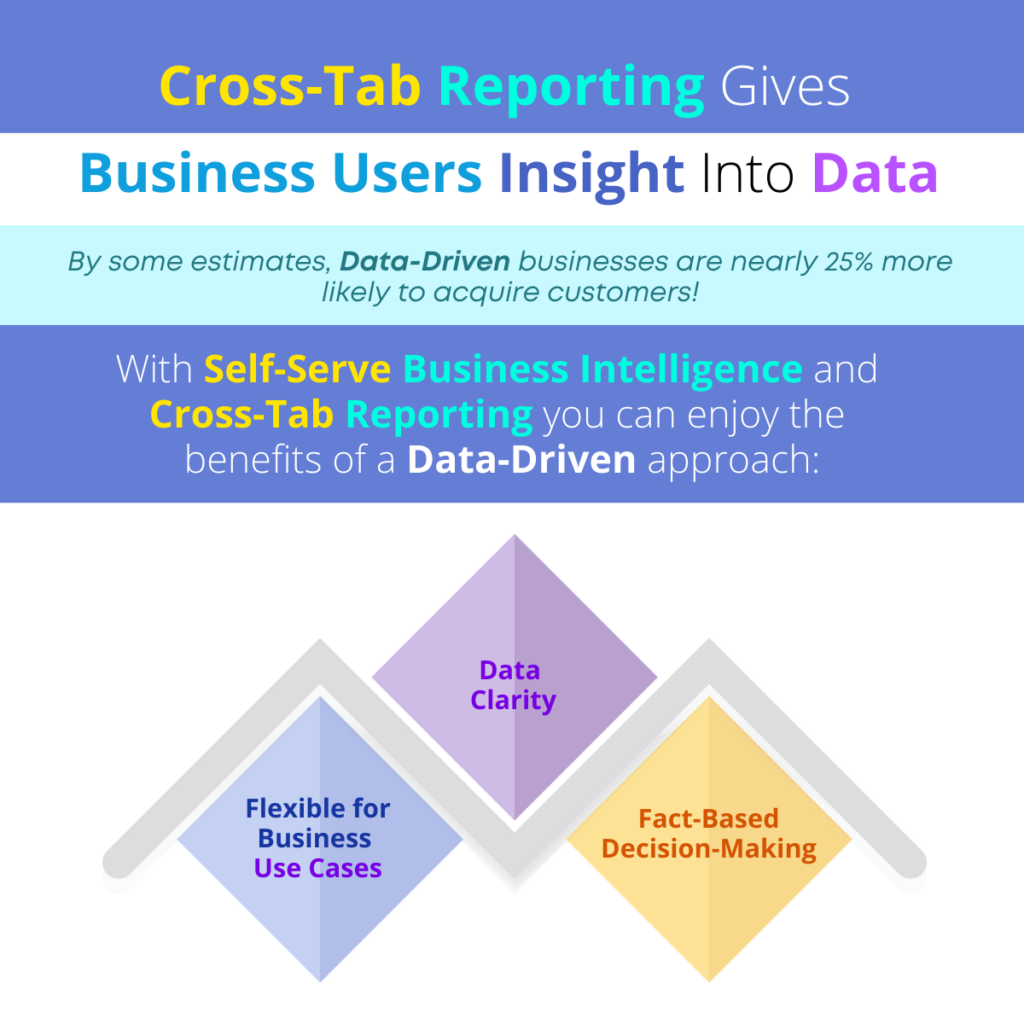
Did you know that, by some estimates, data-driven businesses are nearly 25% more likely to acquire customers? If you can give your team easy-to-use BI tools with self-serve cross-tab reporting, you can put the power of market and customer knowledge in their hands!

‘Business Intelligence solutions with self-serve cross-tab reporting can provide an intuitive, clear method of data analysis for your business users by revealing relationships in a way that makes the results clear and helps the organization to make the best decisions.’

In this article, we discuss the value of self-serve BI tools with Cross-Tab capabilities and the benefits of this type of focus and insight.

Cross-Tab Reporting Gives Business Users Insight Into Data

Benefits of Self-Serve Cross Tabulation Reporting

Flexible for Business Use Cases

Cross-tab reporting allows for intuitive use by business users with average technical skills, and can be beneficial for all types of business functions and industries. In an educational setting, a university or school might use cross-tab reporting to analyze teacher or course evaluations, looking at the relationship between student satisfaction and the subject, the class time, class location and other factors. Businesses can analyze team and employee satisfaction and attrition by looking at job location, benefits, the results of exit interviews, available training, and support, etc. Cross-tab reporting is frequently used in market research to analyze the various factors that relate to product or service satisfaction, including product features and options, where and how the product is sold, the sales and marketing approach, etc. A retail store owner might use cross-tab data analysis to determine customer satisfaction by looking at demographics, the gender of the person buying the product, the price of the product in a particular region, etc.

Data Clarity

There are many ways to slice and dice data and many ways in which crucial information can hide inside that data. The self-serve cross-tab reporting approach allows business users to examine relationships among data points and factors, with more clarity and accuracy. This type of analysis provides more clarity and reveals results, interdependent relationships and factors that might otherwise be missed. Users can avoid confusion when working with data and analyze large datasets to reveal frequencies and percentages. With this information, the business can understand the ‘what if’ of the various factors and see how results would change if one factor or relationship is changed.

Fact-Based Decision-Making

Self-serve cross-tab reporting simplifies analytics and allows business users to spot trends and patterns and collaborate with other team members to adapt tasks and activities to resolve issues and/or capitalize on opportunities. Using cross tabulation reporting to understand the connection and relationship between two or more factors allows the business to make a decision, with confidence. Rather than guessing the reason for declining results, increased employee attrition or other problems, the enterprise can clearly see what factors (and the relationships among factors) are the cause of a problem and how to change those factors to get better results.

‘If you can give your team easy-to-use BI tools with self-serve cross-tab reporting, you can put the power of market and customer knowledge in their hands!’

Business Intelligence solutions with self-serve cross-tab reporting can provide an intuitive, clear method of data analysis for your business users by revealing relationships in a way that makes the results clear and helps the organization to make the best decisions. By giving your team members these tools, you can leverage domain and industry knowledge and combine data analytics in a day-to-day environment without the need for assistance from data scientists or the IT staff. Self-Serve Cross-Tab reporting produces clear results that are easy to understand and can be used in staff meetings and presentations to support recommendations and help the business become more agile.

Look for seamless Business Intelligence Reporting And Flexible Tools that include self-serve Cross-Tab reporting. Provide business intelligence that your IT team can easily implement and support, and a solution that business users will want to adopt. Choose  flexible, agile business intelligence solutions that can be used at all levels to collaborate, share data, and report and communicate with clarity. Self-Serve BI Tools can provide your business with the foundation to achieve your data democratization and user adoption goals.

Original Post : Cross-Tab Reporting Gives Business Users Insight Into Data!

Business Users Love Simple (Yet Sophisticated) BI Tools!

If You Want Business Users to Embrace BI Tools, You Need to Focus on Simplicity!

If your enterprise has not already adopted business intelligence tools, it is missing a crucial benefit in competitive positioning and accurate, dependable decision-making. If your organization has implemented BI tools, but you are falling short on user adoption success, return on investment (ROI) and total cost of ownership (TCO), it is probably because the business intelligence solution is not meant to support business users.

PC Magazine says that, as business users are asked to leverage BI tools, the enterprise must focus on simplicity to engender user adoption.

‘When your team can access BI tools that support the way they work and provide meaningful views and features to easily integrate with work and business processes, user adoption is easier and more immediate.’

To achieve your enterprise goals, ensure user adoption and get the most out of your investment, you must focus on two things: user-friendly features and function and sophisticated analytics.

BI Tool User Adoption Depends on Simplicity!

In this article, we list some of the considerations for business intelligence solution selection or product upgrade. This list is meant to help you assess your current solution, and/or review the capabilities of any BI tool you are considering.

Simplicity in Technology:

  • 100% browser-based solution
  • Intuitive interface
  • Mobile application that is suitable for iOS and Android
  • Simple, affordable licensing
  • Rapid implementation (roll out in minutes, not months)
  • Simple, multi-layered access and user rights management
  • Simple architecture

Simplicity of Use:

  • Ability to personalize dashboards
  • KPI Reporting
  • Easy-to-use reporting tools
  • Collaborative features
  • Social BI for sharing, ranking and commenting
  • Smart Data Visualization
  • Assisted Predictive Modeling
  • Self-Serve Data Preparation
  • Clickless analytics for easy searching and results

The business intelligence tools you select can and should include out-of-the-box, ready-to-use features that are designed to support your applications, your industry, and/or your business function. When your team can access BI tools that support the way they work and provide meaningful views and features to easily integrate with work and business processes, user adoption is easier and more immediate.

‘To achieve your enterprise goals, ensure user adoption and get the most out of your investment, you must focus on two things: user-friendly features and function and sophisticated analytics.’

Look for Ready-To-Use Tools that users will want to adopt. Provide business intelligence that your IT team can easily implement and support, with features your users will readily leverage. Choose  flexible, agile business intelligence solutions that can be used at all levels to collaborate, share data, and report and communicate with clarity. Self-Serve BI Tools can provide your business with the foundation to achieve your data democratization and user adoption goals.

Original Post : BI Tool User Adoption Depends on Simplicity!

Users Love Self-Serve BI and Cross-Tab Analytics!

Ensure Business Users Will Adopt BI Tools with Self-Serve BI and Cross-Tab Analytics!

Gartner has predicted that, ‘90% of corporate strategies will explicitly mention information as a critical enterprise asset and analytics as an essential competency.’ Establishing the strategy is one thing, but getting business users to adopt an analytics and information-based business workflow is quite another.

‘Modern business intelligence tools that are designed with self-serve features makes it easy enough for every user (no matter their technical skill) to leverage analytics to report, share and collaborate.’

When it comes to teams, there are two things that are always true: 1) they learn a process and workflow and rarely want to change that familiar process and 2) they are always suspicious of ‘new’ initiatives and nearly always believe that these new initiatives will result in more work for them. There is a reason your team resists new processes and initiatives and that reason is simple. Usually, their fears are warranted!

So, if you want to engender support for new analytics initiatives and engage a business community in fact-based, action-oriented initiatives, you need to plan this new initiative with your users in mind.

In this article, we focus on two of the primary components of a new business user analytics initiative.

Enable User Adoption with Self-Serve BI and Cross-Tab Analytics

Self-Serve BI Tools

Modern business intelligence tools that are designed with self-serve features like smart data visualization, self-serve data preparation and assisted predictive modeling make it easy enough for every user (no matter their technical skill) to leverage analytics to report, share and collaborate. By adding value to the user’s everyday tasks and reducing the rework and issues they will confront, you can encourage your users to adopt analytics initiatives.

  • Any promotion of analytics strategy must clearly illustrate business use cases and benefits of these tools.
  • Support a more productive, streamlined environment that will allow them to do more with less and get the job done quickly.
  • Ensure that business users can collaborate and share and grow their own expertise and visibility.
  • Provide measurable results and information to make recommendations and support those recommendations.

Cross-Tab Analytics Capabilities

Those self-serve tools should include reporting and graphical tools that are clear and concise. Business users don’t want tools that produce complex reports filled with columns and mind-numbing numbers that do not help them reach a decision or illustrate an issue. Cross-tab analytics have been around for some time but the new, improved versions of this capability provides real insight into data in a way that is clear for every user. Sophisticated functionality is underpinned with easy-to-use tools so users can analyze the relationship between or among two or more variables and summarize data in rows and columns making it easy to understand the relationships and intersection of the various types of data. Understanding relationships in data is crucial to identifying the root cause of a problem or to targeting an issue or identifying a business opportunity. Your team members can work with multi-dimensional data and perform ad-hoc queries to gain a clear view of performance, dive into your data, and find and understand the data they need quickly and intuitively. Cross-tab analysis simplifies complex data operations, summary operations, time series functions, filters and custom column expressions and enables business users with simple tools they can really use.

‘If you want to engender support for new analytics initiatives and engage a business community in fact-based, action-oriented initiatives, you need to plan this new initiative with your users in mind.’

Business Intelligence tools can improve your business results. If your business understands the challenges of implementing a business intelligence solution and adequately plans for implementation and user adoption, it can leverage the benefits of these tools and solutions and ensure success. Let us help you achieve your vision and improve productivity and insight across the organization.

Original Post : Enable User Adoption with Self-Serve BI and Cross-Tab Analytics!

Will My Business Benefit from Mobile Analytics for Tally ERP?

How Do I Know if I Need to Integrate Analytics with My Tally ERP Solution?

You made sure you gave your business users the software they need to support their business function. Tally® ERP is popular among your team members. Accountants are using the appropriate module to enter data and print reports. Inventory managers are managing stock, and purchasing managers are coordinating suppliers, supplies and expenses. But you’ve been hearing about analytics at all the conferences and in the industry trade papers and you wonder whether you need to take your Tally ERP solution to the next level with integrated analytics.

‘Your users can still enjoy the familiar features and functionality of Tally ERP while adding the capabilities of integrated augmented analytics and out-of-the-box reporting to enable data-driven decisions,’

Gartner predicts that, ‘By 2023, overall analytics adoption will increase from 35% to 50%, driven by vertical- and domain-specific augmented analytics solutions.’ While your business may not be in a narrow vertical industry or a market with limited competitive dimensions, the concept of vertical and domain specific analytics can be applied to financial service practices or to a business unit within any enterprise that is dedicated to accounting, managing finances, controlling expenses etc. The reason is simple. No matter the type of company or industry in which is participates, the needs, regulatory specifications and requirements for reporting are specific to accounting, finance, and other departments that control investment, expenses and revenue.

If your business is considering adding integrated analytics to your existing Tally ERP solution, here are some things to consider that may help you answer the question, ‘how do I know if I need to integrate analytics with my Tally ERP solution.’

Should I Add Integrated, Mobile Analytics to Tally ERP?

You Need Clear, Concise Information

When your business users are confined to the data and reports for their particular function, e.g., accounting or inventory, there is no flexibility and no way (short of expensive customization or IT report requests) to create a clear picture of a particular issue or question. Business user access to reports and data is restrictive and limited to columns and simple graphs that do not tell a story or reveal the root cause of a problem or the hidden opportunities within the data to improve products, pricing, purchasing agreements, tax strategies, investment opportunities, etc.

You Need Reporting and Analytics that Cross Business Functions

Users do not have access to comprehensive reporting for sales, tax, receivables, payables, cash, banking, accounting statements or other needs but rather must depend on simple templates and reports. Reporting is limited to a particular business function and data cannot be gathered across modules and analyzed to highlight issues that cross business function boundaries or opportunities for collaboration or process improvement.

You Need Mobile Access to Workflow and Reporting

Users are limited to desktop or, in some cases, browser access. No true, flexible mobile access is available to accommodate native operating systems (OS) and provide simple, user-friendly analytics for team members who must perform tasks, analyze data and report and share information while on the road.

You Need Measurable Results

Your business has the data in Tally ERP but needs to establish and monitor key performance indicators (KPIs) and provide metrics for measurable results against objectives and goals.

If some or all of these issues sound familiar to you, your business may wish to consider simple, integrated, mobile augmented analytics for Tally ERP.

‘You’ve been hearing about analytics at all the conferences and in the industry trade papers and you wonder whether you need to take your Tally ERP solution to the next level with integrated analytics.’

Your users can still enjoy the familiar features and functionality of Tally ERP while adding the capabilities of integrated augmented analytics and out-of-the-box reporting to enable data-driven decisions, gain insight into issues, and identify opportunities with intuitive dashboards, KPIs and reporting. Users can analyze data using a myriad of value-added tools and features.

Find out how the addition of SmartenApps For Tally will support your accounting-related analytical initiative and bring your team and your business to the next level. Users can Download And Register for SmartenApps for Tally and use Tally data to analyze, explore and clarify.

How Do I Know if I Need to Integrate Analytics with My Tally ERP Solution?

Adding Analytics to Tally ERP Can Improve ROI!

How Can I Improve ROI for Tally ERP? It’s Simple! Add Analytics!

Surveys reveal that the top three vertical industries currently using Tally ERP include Manufacturing, Retail and Real Estate. No matter what your business industry is, if you are using Tally ERP, you want to get the most out of your investment. As with any software solution, IT teams and executives constantly look for the tools that will give them the most benefit and value for the least investment. So, Return on Investment (ROI) is paramount!

‘Using the existing data and data structure within Tally ERP, analytical tools can provide additional insight and value to the organization, to business users, to clients and to the bottom line.’

If you are using Tally ERP, your team members probably depend on it for accounting, inventory, purchasing, sales, and other finance-related and data management activities. Why not add more value to the organization and to the clients and colleagues it serves?

Minimum Viable Products (MVP) Produces Better Business Start-Up Results

Provide Value to the Organization, Users and Clients

Today, Tally ERP provides an integrated data analytics solution with out-of-the-box reporting and tools that are easy enough for every team member, no matter their technical skills. By enabling business users to sign in to Tally ERP and gather and analyze data across modules with clear, concise reporting, the enterprise can make decisions more quickly, add value in making recommendations to business units and, in a practice management environment, to clients, and thereby improve return on investment (ROI) and customer/client and user satisfaction.

Ensure Mobile and In-Office Access for Users

Cloud-based access through the web or a native mobile app provides access from anywhere and allows users to perform tasks, check on transactions in near real-time, and keep workflow going whether they are working remotely, on the road to a client meeting or in the office. Business users can leverage the familiar Tally ERP app without having to learn difficult, complex analytical techniques or new solutions.

Expand Insight and Reporting Capabilities

The key to improving ROI and the value your team delivers lies in combining team member knowledge of their domain and area of expertise with clear, concise data. By going beyond standard, restrictive reporting and enabling analytics, business users can see trends and patterns, problems and opportunities.

Serve All Business Users with Meaningful, Easy-to-Interpret Data

Sales Managers can monitor and manage sales for monthly, quarterly and yearly results and identify trends, top customers etc. Customer service, supplier and other management teams can manage payables and receivables and stay on top of creditors and debtors and can easily analyze the success and trends of products, services and components. Inventory managers can analyze shortages and overages, suppliers, products, shipping and distribution. Tax professionals can manage and anticipate taxes for future periods. Business users can monitor and manage cost center balances. The list is endless and the tools provided allow users to drill down to the ledger and transaction level to better understand what is happening. Reports are interactive and allow team members to slice and dice data across modules by vendor, product, service, cost, sales person, location, customer, inventory, costs, etc. Using the existing data and data structure within Tally ERP, these analytical tools can provide additional insight and value to the organization, to business users, to clients and to the bottom line.

‘The key to improving ROI and the value your team delivers lies in combining team member knowledge of their domain and area of expertise with clear, concise data.’

Find out how the addition of SmartenApps For Tally will support analytical initiatives, improve Return on Investment (ROI) for Tally ERP, and  provide benefits to your users and your enterprise. Users can Download And Register for SmartenApps for Tally and use Tally data to analyze, explore and clarify and to provide insight to clients, colleagues, management and team members.

Can Democratizing BI Use Help My Team?

Why is Business Intelligence Democratization Important for My Business?

Gartner research reveals that, ‘80% of organizations seeking to scale digital business will fail because they do not take a modern approach to data and analytics governance.’

If you are considering democratizing business intelligence gathering and analytics, you are not alone! Businesses today face more competition from local and global markets and every team member must work quickly and accurately in support of goals and objectives if the enterprise is to achieve its goals.

‘When senior executives and managers have reliable information and dependable recommendations and suggestions, they can improve performance and accuracy in forecasting, planning and demand.’

In this article, we discuss a few of the reasons a business should consider democratizing business intelligence and analytics within its team and how this type of initiative can be implemented to help your enterprise succeed.

Should I Democratize Business Intelligence in My Business?

Working Smarter

When you provide BI tools to your business users, you democratize data and begin to build a better understanding of the root cause of problems, the opportunities the business can leverage and the way forward to solving problems and creating business success. Team members can work smarter, with quick, concise access, and insight into data via self-serve solutions that streamline and simplify the typically complex analytical process and allow every team member to perform the analysis and, more importantly, to understand what the results are telling them.

Focusing on Core Responsibilities

When you democratize business intelligence and analytics with augmented analytics tools, IT team members, data scientists and business analysts can focus on strategic goals and on initiatives where data must be 100% accurate. Team members can use BI tools on a daily basis to test theories and gather and analyze information to support activities and tasks, collaborate with others and move forward, so EVERYONE can focus on their own roles and core responsibilities.

Supporting the Greater Good

When senior executives and managers have reliable information and dependable recommendations and suggestions, they can improve performance and accuracy in forecasting, planning and demand. Team leaders, business unit managers and others can realize long-term benefits and count on the fact that all team members are working with the right information, that information and analysis is based on current, integrated data and on measurable results. The organization can shift to a results-based environment where problems are analyzed and resolved and opportunities are leveraged to the greatest extent possible, so the enterprise can create an environment of continuous improvement.

Creating a Common Language

When all team members are using business intelligence to test theories and hypothesize, to solve problems and get to the root of a problem, to identify those all-important ‘nuggets’ of information that make a competitive difference, managers and executives can feel confident that the team is speaking a common language and that every team members knows how to find a problem, how to explain that problem and how to dependable recommendations to solve that problem.

‘Businesses should consider democratizing business intelligence and analytics within teams to help the enterprise succeed.’

Business Intelligence tools can support data democratization and improve your business results. If your business understands the challenges of implementing a business intelligence solution and adequately plans for implementation and user adoption, it can leverage the benefits of these tools and solutions and ensure success. Let us help you achieve your vision and improve productivity and insight across the organization.

Original Post : Should I Democratize Business Intelligence in My Business?

Integrated Tally Mobile Analytics Improves ROI and TCO!

Increase the ROI and TCO of Tally ERP with Integrated Tally Mobile Analytics!

If you are considering, or have already purchased software, you probably faced the questions from your management team about return on investment (ROI) and total cost of ownership (TCO). No doubt, your team did their homework when the business acquired Tally® ERP software.

‘Out-of-the-Box analytics tools allow the user to leverage and optimize the existing technology in new ways.’

Gartner defines total cost of ownership as ‘a comprehensive assessment of information technology (IT) or other costs across enterprise boundaries over time.’ Forbes defines return on investment (ROI) as ‘…a metric used to understand the profitability of an investment. ROI compares how much you paid for an investment to how much you earned to evaluate its efficiency.’

On the surface, the calculations for TCO and ROI may seem simple.

TCO = Acquisition cost + Service/Maintenance cost – Salvage value

ROI = Net Income/Cost of Investment

But while these calculations provide a starting point for investment decisions, the impact of ROI and TCO on the team is something business users will live with every day. When it comes to the popular Tally solution, business managers, accountants and finance professionals have embraced and are using the various modules to support sales, manufacturing, accounting, finance, inventory, purchasing and other functions.

Your business can improve ROI and TCO for Tally by adding integrated augmented analytics. In this article we discuss how Tally Mobile Analytics can improve ROI and TCO for the business.

Improve Tally ERP ROI and TCO with Tally Mobile Analytics

User Adoption

While your users are probably used to Tally and leveraging the module(s) that are most suitable for their role, there are probably team members who don’t use the solution as often as you might like. They may feel it is restrictive and limited to data entry or simple reporting. If they ARE using it, they may not find all the information they need and therefore will not be champions of the software. There is a lot to like about Tally ERP and a lot of capabilities and functionality. By adding integrated augmented analytics with features and sophisticated analytics that are easy enough for the average business user, the team is more likely to adopt and get the most out of the Tally investment. Expanded capabilities for built-in reporting and analytics will allow users to provide more value to clients and colleagues and this is likely to encourage user adoption as it will support career visibility, etc.

Optimization of Technology

Optimizing your investment in software is always important. If you are able to make the most out of the tools by providing an overlay of analytics, the data that already resides in your software and data source is more readily accessible. Out-of-the-Box analytics tools allow the user to leverage and optimize the existing technology in new ways.

Optimization of Resources

Every business is short-handed today, and the expansion and growth of digital tools and processes has allowed business users to do more and to be more productive. Getting to the information quickly, without the assistance of IT or data scientists or business analysts allows the user to ask a question, get an answer, make a recommendation, share data and move on. The enterprise can offer tools to its team without the frustration of extensive training and complex, time-consuming search and analytical techniques, thereby improving productivity and making the organization more agile.

Mobile Access

Nearly every business today has remote workers and staff on the road, working out of a hotel room or in an airport. By providing mobile access to analytics and to the Tally ERP data, the organization can leverage its investment 24/7, without experiencing delays in workflow or output. Near real-time analytics and access to reports, tasks and data sharing allows the business to move faster and more precisely.

‘Your business can improve ROI and TCO for Tally by adding integrated augmented analytics.’

Find out how the addition of SmartenApps For Tally can help your business improve ROI and TCO, support your accounting-related analytical initiative and bring your team and your business to the next level. Users can Download And Register for SmartenApps for Tally and use Tally data to analyze, explore and clarify.

Increase the ROI and TCO of Tally ERP with Integrated Tally Mobile Analytics

Integrate Tally ERP and Analytics and Succeed!

Why Does My Business Need to Add Analytics to Tally ERP?

If your business is currently using Tally ERP, your business users are familiar with the features and the data structure of the module they use, whether they are an accounting professional, managing inventory, reviewing sales or preparing statutory financial reports. Your management team may be considering adding analytics to your organization in order to democratize data and to improve fact-based decision making. If the organization decides to add analytics to the Tally ERP environment, it will have the best of both worlds.

Gartner states that, ‘90% the world’s top 500 companies will have converged analytics governance into broader data and analytics governance initiatives.’ There are many reasons a business leader will converge analytics and other initiatives. One of these reasons is that the integration of analytics into other work processes and activities ensures successful deployment of analytics throughout the enterprise.

‘By adding analytics to the Tally ERP environment, the enterprise can improve organizational agility, increase the value of existing team member knowledge and experience and avoid creating data silos that will inhibit user adoption.’

In this article, we take a look at why it is wise to integrate your Tally ERP solution with integrated analytics and how it can benefit your enterprise.

Do I Need to Integrate Analytics with Tally ERP?

One-Stop Analytics

When you integrate augmented analytics with the familiar Tally ERP solution, users can leverage their favorite application to prepare and perform analytics. There is no need to frustrate users with data silos and new applications that are complex and difficult to use. Using out-of-the-box analytics with sophisticated functionality in an easy-to-use environment, users can analyze and report on sales, purchasing, bank, cash, payables, receivables, inventory, taxes, cost centers, ledgers and account statements.

Value Add

Financial, accounting and other professionals can add more value to the organization, to business units, to clients and to colleagues by performing analytics across modules, leveraging pre-built reports and gaining insight into data. Your finance-related teams will be welcomed as crucial team members and can provide clarity and help the organization use the data contained within the Tally ERP solution to understand issues and opportunities and identify trends.

No Advanced Skills Required

Using domain, topic and career experience, your finance-related team members can prepare, analyze and understand data and information without the assistance of IT team members or data scientists. This allows the organization to democratize data and improve data literacy and takes the professional business users beyond data entry and into the realm of analytics without asking them to learn new technology skills.

By adding analytics to the Tally ERP environment, the enterprise can improve organizational agility, increase the value of existing team member knowledge and experience and avoid creating data silos that will inhibit user adoption.

‘Your management team may be considering adding analytics to your organization in order to democratize data and to improve fact-based decision-making.’

Find out how the addition of SmartenApps For Tally will support analytical initiatives and provide benefits to your users and your enterprise. Users can Download And Register for SmartenApps for Tally and use Tally data to analyze, explore and clarify and to provide insight to clients, colleagues, management and team members.

Small & Medium Businesses Need Tally ERP Mobile Analytics!

3 Ways Integrated Tally Mobile Augmented Analytics Can Help Small and Medium Businesses!

As a Tally® ERP user, your business already knows the value of this solution. The Tally solution provides businesses with tools to manage all critical aspects of your business, including accounting, sales and purchase, inventory, manufacturing, taxation, payroll, MIS reporting, etc. As your enterprise grows, and markets become more competitive, it is important to add capabilities that will allow you to be more competitive and help you understand what is happening in your business, what processes, products and activities are helping you to achieve your goals and where you need to adapt.

By integrating augmented analytics into your Tally solution, your team members can leverage analytical tools in an easy-to-use, out-of-the-box environment to produce reports and share data that will offer insight into your business results and strategies.

‘…team members can be creative and innovative in their recommended solutions and, more importantly, can discover the reasons for success or shortfalls.’

By some estimates, the financial analytics market has the potential to reach nearly ten and half million US dollars by 2023. The growth of this market is evidence that businesses are embracing the need for analytics. But when it comes to small and medium sized businesses, the budget for data scientists, analysts and complex analytical solutions is slim to none.

In this article, we discuss three ways that integrated augmented analytics can add to the existing value of the Tally ERP solution and help business users achieve results and gain insight for decision-making and recommendations.

3 Advantages of Tally Mobile Analytics for SMEs

Clear, Concise Reporting Built for Business Users

While Tally ERP provides its own reporting capability, adding flexible analytics reports for sales and purchasing, banking and cash analytics, payables and receivables, inventory management, taxes, cost center and ledger analysis, account statements and drill-down capabilities allows the user to gather data and analyze it across modules and to discover the root cause of an issue, or identify a product, pricing, supplier or other opportunity to leverage in the market. Small and medium sized businesses are often short on resources and users have little time to learn new software or play with report formats to get what they want. By providing a set of built-in reports, business users can be more productive and get the information they need AND they can share that information.

Seamless Access in the Office and On the Road

Nearly every team member in a small or medium sized business has multiple roles and is often on the road or working remotely. Integrated augmented analytics that is accessible in near real-time via mobile or web access allows the user to make the best use of their time and to perform tasks and analyze data from anywhere.

Suitable for all Finance and Accounting Roles

Many best-of-breed solutions are designed to support a specific need within the organization. Accounting systems are designed for accounting professionals, inventory systems are typically designed as part of an ERP system and support the needs of inventory managers. Tally ERP has modules that are designed for sales, accounting, finance, inventory and other roles. By integrating augmented analytics within this environment, every professional (no matter their role) can use the solution in a way that is best suited for their needs. An additional advantage is the ability to perform simple queries across modules and data so a sales manager might spot a problem with an ad campaign scheduled to promote a product for which there is little inventory, or a purchasing manager might create a report to reveal where bulk orders for multiple business units might result in lower pricing. In truth, while every professional has a specific role, many responsibilities and tasks cross over from one department to another and, with the ability to perform searches and analytics that incorporate data from across the enterprise, team members can be creative and innovative in their recommended solutions and, more importantly, can discover the reasons for success or shortfalls.

‘By integrating augmented analytics into your Tally solution, your team members can leverage analytical tools in an easy-to-use, out-of-the-box environment.’

Find out how the addition of SmartenApps For Tally will support your accounting-related analytical initiative and bring your team and your business to the next level. Users can Download And Register for SmartenApps for Tally and use Tally data to analyze, explore and clarify.

3 Ways Integrated Tally Mobile Augmented Analytics Can Help Small and Medium Businesses

Original Post : 3 Advantages of Tally Mobile Analytics for SMEs!